

#
Naming Convention
.NET Reactor offers various schemes of how your classes and members will be renamed during obfuscation.
#
Debug
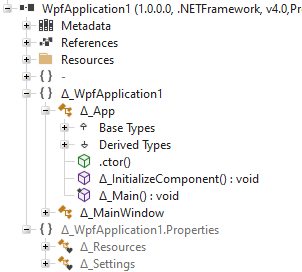
Debug adds the prefix 'Δ_' to the original names. This makes it easy to see which classes and members are renamed through obfuscation. For a diagnostic workflow, see Debugging.
Debugging only
Do not distribute software with the Debug naming convention.
#
'A' Overload
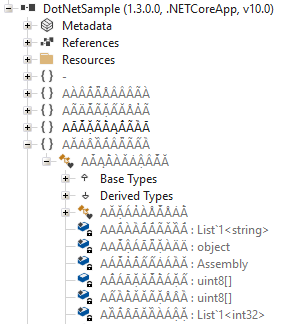
A-Overload replaces readable identifiers with repetitive sequences of visually similar Unicode variants of the letter A, such as À, Á, Â, Ã, Ä, and Å. The subtle differences between these characters make obfuscated names difficult to distinguish when browsing an assembly or reading decompiled code, making manual analysis more challenging.
#
Incremental
If you want .NET Reactor always to generate the same obfuscation strings for your type and member names, you need to enable this option.

#
Standard
This is the default scheme.

#
Stealth
Generates random, meaningful names for obfuscated classes and members. This way it is less obvious which parts are obfuscated. For most cases 'Stealth' is the recommended option.

#
Strange
Uses weird and displaced characters which confuse most decompiler code views. Only enable this feature if you don't want to use the protected assembly in a development environment(Visual Studio etc.).

#
Unprintable Characters
Uses unprintable strings to obfuscate type and member names. Only enable this feature if you don't want to use the protected assembly in a development environment(Visual Studio etc.).
